ADDITIONAL MENU
Vol. 1 No. 1 (2026): April 2026
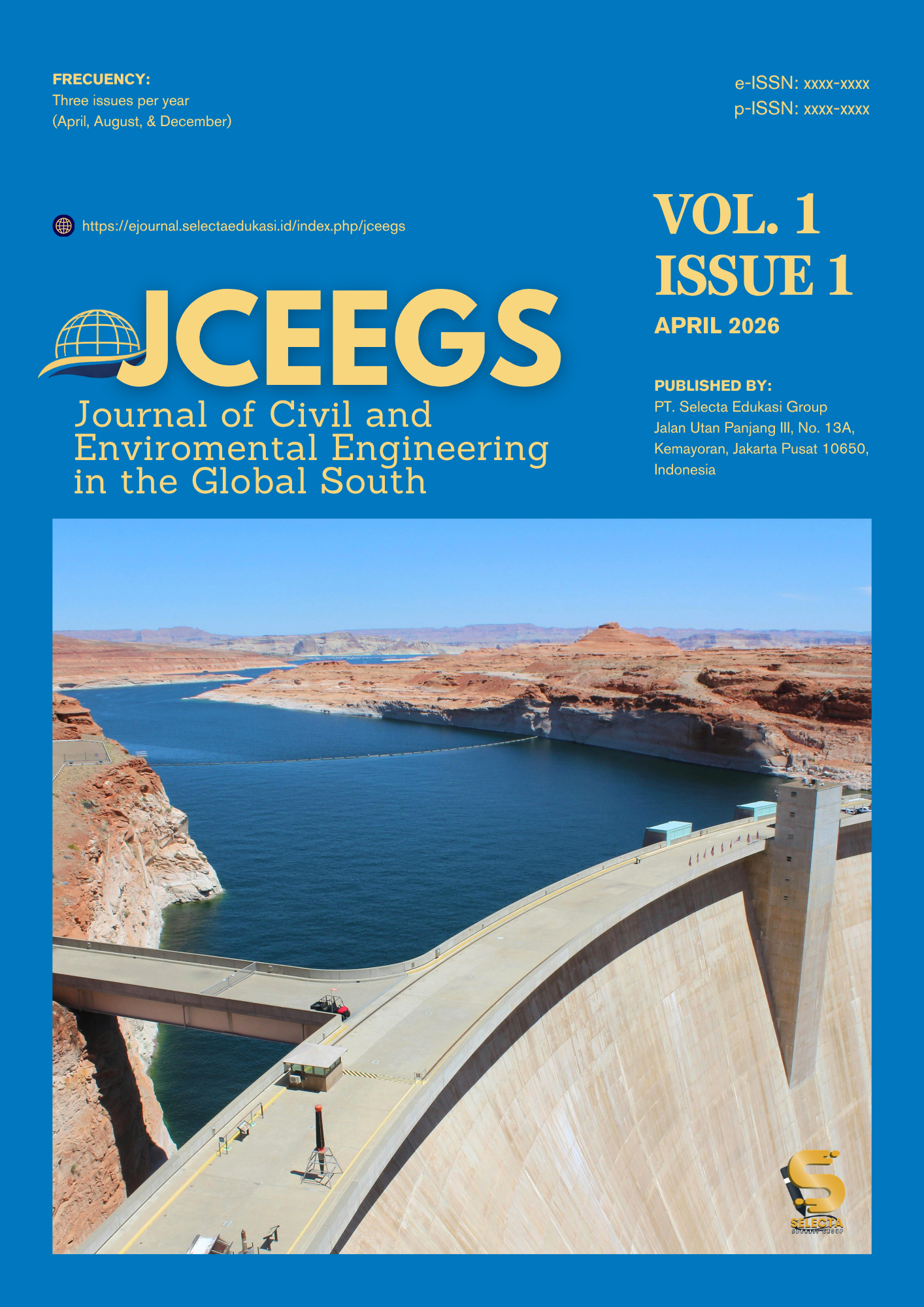
Volume 1, Issue 1 (April 2026) of the Journal of Civil and Environmental Engineering in the Global South (JCEEGS) brings together a set of contributions that exemplify the journal’s commitment to technically rigorous yet contextually grounded engineering scholarship. The articles in this inaugural issue collectively engage with pressing infrastructural and environmental challenges across Indonesia, ranging from bridge systems and slope stabilization to pavement deterioration, housing rehabilitation, and project performance management. Rather than treating engineering as a purely technical endeavor, these studies situate design, construction, and maintenance practices within broader socio-material realities, where constraints such as high traffic loads, seismic vulnerability, and resource limitations shape both problems and solutions.
A notable strength of this issue lies in its comparative and integrative approaches. Several articles advance the field by juxtaposing alternative engineering systems—such as asphaltic plug versus strip seal joints, and cantilever versus gravity retaining walls—while incorporating economic, safety, and long-term sustainability considerations. Others contribute methodological innovation, including predictive modeling of pavement deterioration and the application of Earned Value Management as a diagnostic tool for infrastructure project performance. Together, these works highlight how data-driven analysis, combined with field-based evidence, can inform more adaptive and efficient decision-making in infrastructure planning and management.
Taken as a whole, the issue reflects JCEEGS’s broader intellectual agenda: to bridge the persistent gap between engineering theory and the complex realities of the Global South. The contributions not only offer practical insights for improving infrastructure resilience, cost efficiency, and environmental sustainability, but also reposition local contexts as sites of innovation and knowledge production. In doing so, this inaugural volume sets a strong foundation for future scholarship that is both globally relevant and deeply attuned to the diverse conditions shaping engineering practice in the Global South.