ADDITIONAL MENU
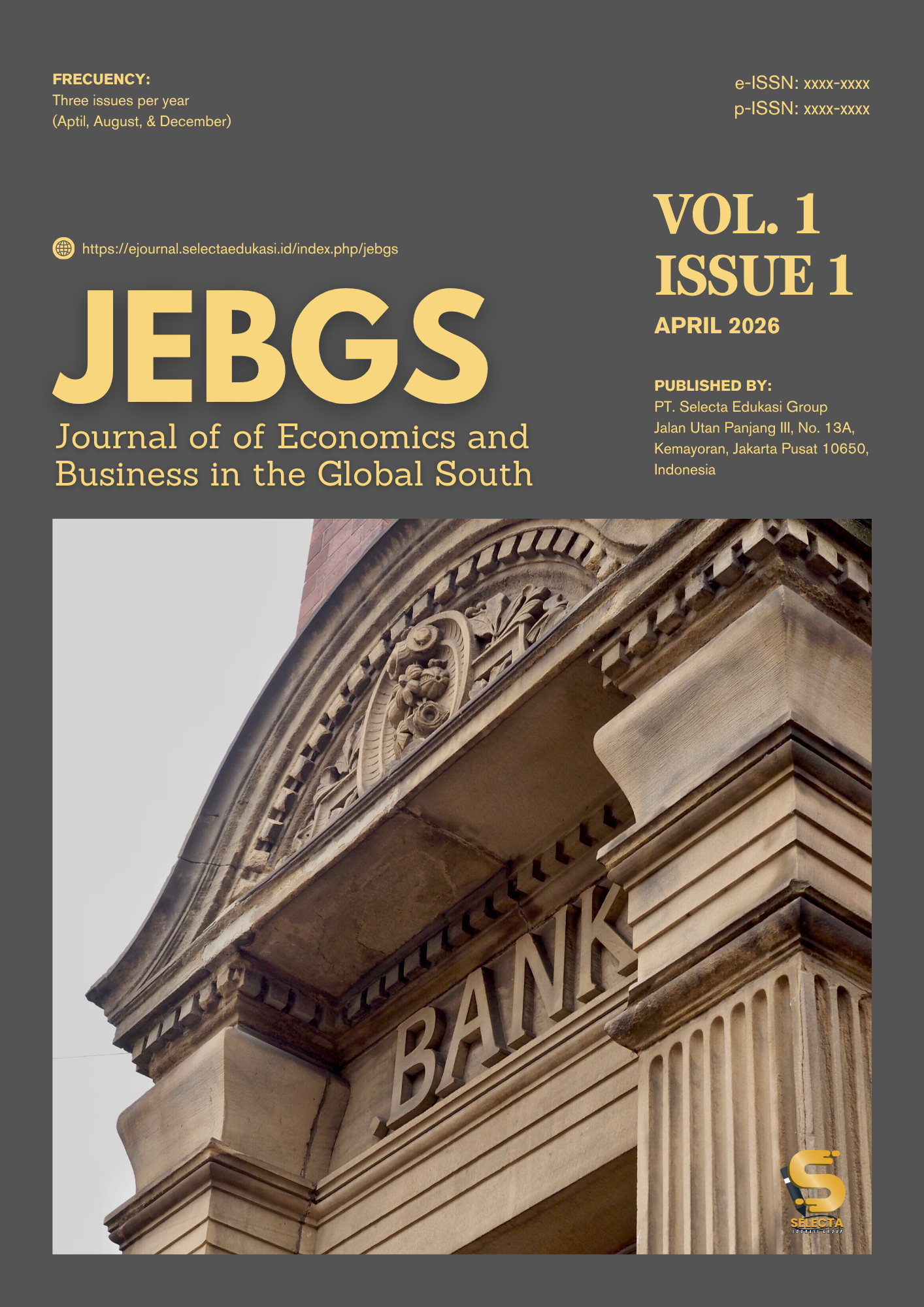
Vol. 1 No. 1 (2026): April 2026
Volume 1, Issue 1 (April 2026) of the Journal of Economics and Business in the Global South (JEBGS) sets a strong and purposeful tone for the journal’s trajectory. This inaugural issue positions the Global South not simply as a field of observation, but as an active site of knowledge production, offering grounded and critical insights into contemporary economic and business dynamics.
The articles in this issue engage with a range of pressing and interconnected concerns. One study highlights how economic inequality in Jakarta’s Pulogebang slum area intersects with civil identity exclusion, producing layered forms of educational marginalization and reinforcing cycles of urban poverty. Another contribution examines the impact of urban gentrification in Bandung, drawing attention to how street vendors navigate displacement, negotiate policy constraints, and sustain informal economic practices amid rapid urban transformation.
Digital transformation is addressed through an analysis of hybrid market practices among Tanah Abang traders, showing how offline social relations are not displaced but reconfigured through digital platforms, reshaping forms of trust and social capital. Complementing this, a study on Minangkabau women explores how collective financial mechanisms—ranging from cooperatives to locally rooted julo-julo and Islamic microfinance—enhance economic bargaining power within specific market and socio-cultural contexts.
Finally, the issue includes a socio-economic analysis of the implementation of Qanun LKS in Aceh, illustrating how regulatory frameworks grounded in local Islamic values generate both institutional adaptation and social negotiation, particularly in the pursuit of inclusive financial systems.
Taken together, the contributions in this issue reflect the journal’s commitment to theoretically informed, empirically rich, and context-sensitive scholarship. They foreground the diversity of economic practices and institutional arrangements across the Global South, while also offering insights that speak to broader debates in economics and business.