ADDITIONAL MENU
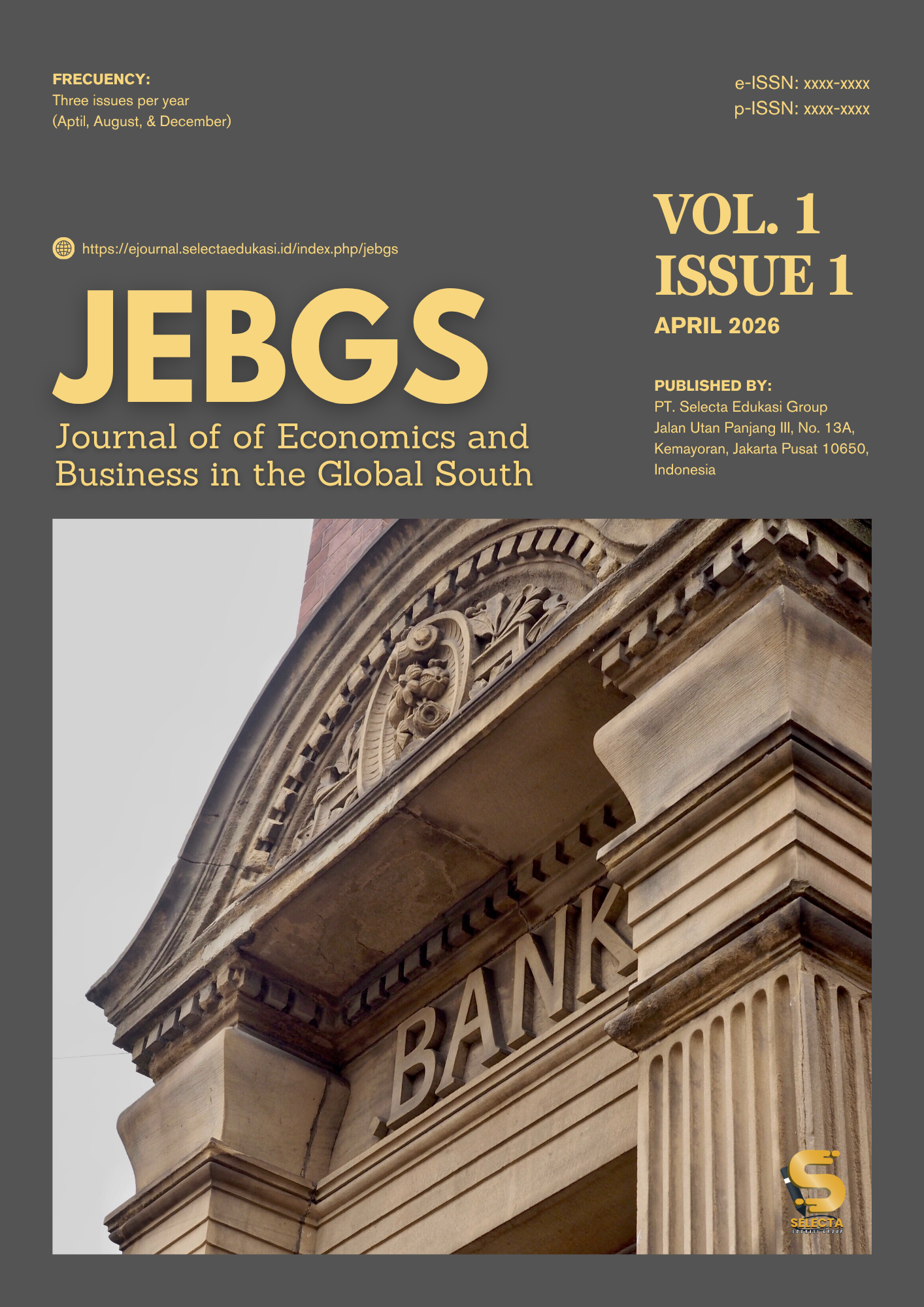
About the Journal
| Journal Title | : | Journal of Economics and Business in the Global South |
| Initials | : | JEBGS |
| Frequency | : | Three issues per year (April, August, & December) |
| Online ISSN | : | 228X8XXX |
| Print ISSN | : | XXXX-XXXX |
| Editor in Chief | : | Dr. Raden A. A. Asnawi, S.E., M.Si. | SINTA | SCOPUS |
| DOI | : | 10XXXXX |
| Publisher | : | PT. Selecta Edukasi Group |
Journal of Economics and Business in the Global South (JEBGS) is a leading international, peer-reviewed journal that positions the Global South not merely as an object of study, but as a critical site of knowledge production in economics and business. The journal is dedicated to advancing rigorous, innovative, and contextually grounded scholarship that challenges dominant paradigms and amplifies diverse perspectives from developing and emerging economies.
In an era marked by deepening global inequalities, economic restructuring, and rapid digital transformation, JEBGS seeks to foreground the unique trajectories, institutional complexities, and adaptive strategies that characterize economies and business systems across the Global South. The journal actively promotes research that interrogates universal economic assumptions and offers alternative frameworks rooted in local realities, indigenous knowledge, and hybrid institutional arrangements.
JEBGS welcomes high-quality contributions that demonstrate strong theoretical engagement, methodological rigor, and clear empirical relevance. The journal particularly values interdisciplinary and comparative approaches that connect economics and business studies with broader socio-political, cultural, and environmental contexts. By doing so, JEBGS aims to foster a more inclusive and pluralistic global discourse in economics and business scholarship.
The journal publishes original research articles, critical reviews, and policy-relevant studies addressing a wide range of topics, including but not limited to development and political economy, financial inclusion, entrepreneurship and MSMEs, digital and platform economies, sustainable and inclusive business practices, governance and institutional reforms, and economic resilience in vulnerable regions.
JEBGS operates under a strict double-blind peer review process and upholds the highest standards of publication ethics, transparency, and academic integrity. The journal is committed to disseminating impactful research that not only contributes to academic debates but also informs policy and practice across diverse Global South contexts.
By prioritizing voices, cases, and innovations from underrepresented regions, JEBGS aspires to become a key reference in shaping a more equitable, context-sensitive, and globally relevant body of knowledge in economics and business.
Current Issue
Volume 1, Issue 1 (April 2026) of the Journal of Economics and Business in the Global South (JEBGS) sets a strong and purposeful tone for the journal’s trajectory. This inaugural issue positions the Global South not simply as a field of observation, but as an active site of knowledge production, offering grounded and critical insights into contemporary economic and business dynamics.
The articles in this issue engage with a range of pressing and interconnected concerns. One study highlights how economic inequality in Jakarta’s Pulogebang slum area intersects with civil identity exclusion, producing layered forms of educational marginalization and reinforcing cycles of urban poverty. Another contribution examines the impact of urban gentrification in Bandung, drawing attention to how street vendors navigate displacement, negotiate policy constraints, and sustain informal economic practices amid rapid urban transformation.
Digital transformation is addressed through an analysis of hybrid market practices among Tanah Abang traders, showing how offline social relations are not displaced but reconfigured through digital platforms, reshaping forms of trust and social capital. Complementing this, a study on Minangkabau women explores how collective financial mechanisms—ranging from cooperatives to locally rooted julo-julo and Islamic microfinance—enhance economic bargaining power within specific market and socio-cultural contexts.
Finally, the issue includes a socio-economic analysis of the implementation of Qanun LKS in Aceh, illustrating how regulatory frameworks grounded in local Islamic values generate both institutional adaptation and social negotiation, particularly in the pursuit of inclusive financial systems.
Taken together, the contributions in this issue reflect the journal’s commitment to theoretically informed, empirically rich, and context-sensitive scholarship. They foreground the diversity of economic practices and institutional arrangements across the Global South, while also offering insights that speak to broader debates in economics and business.