About the Journal

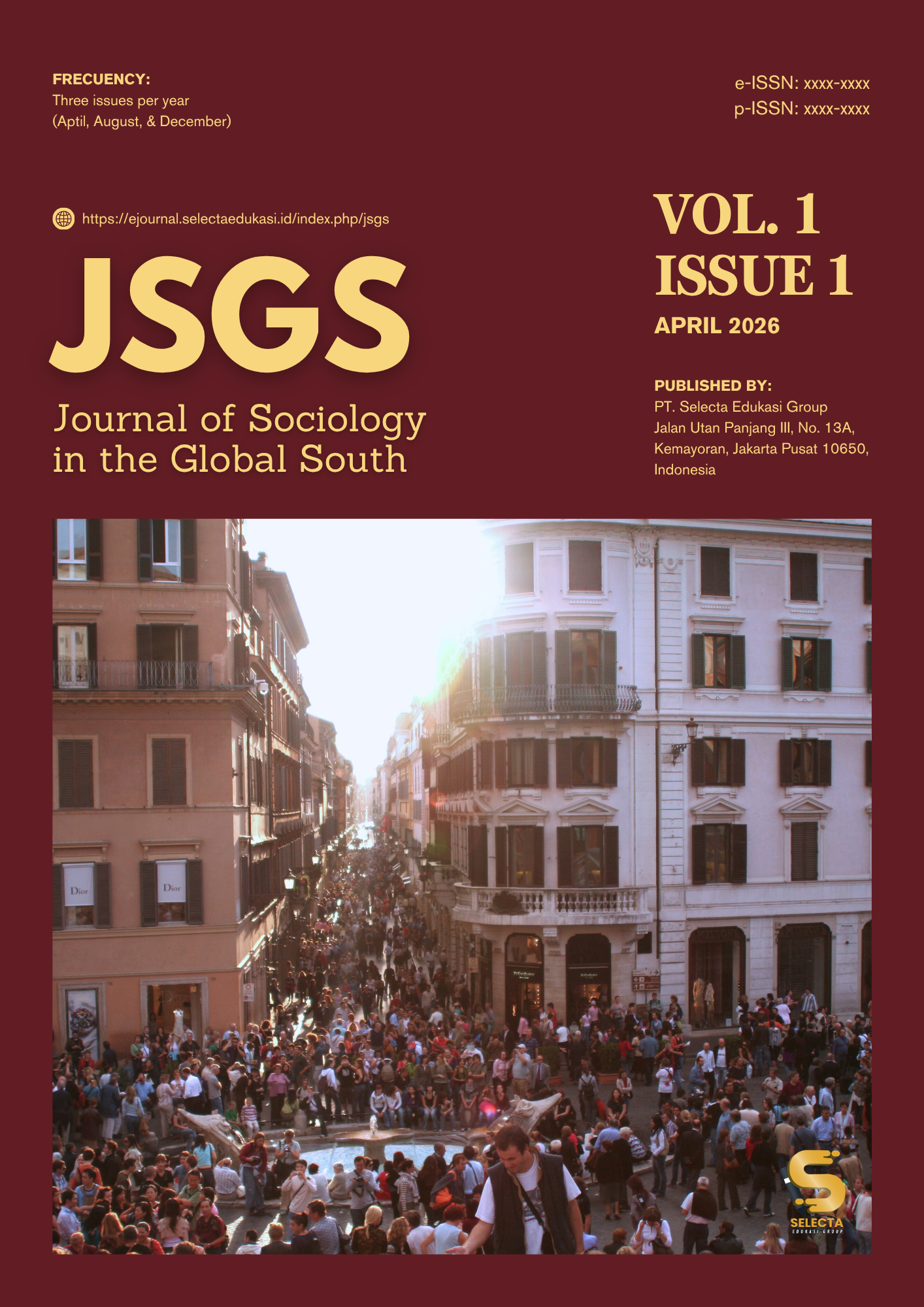
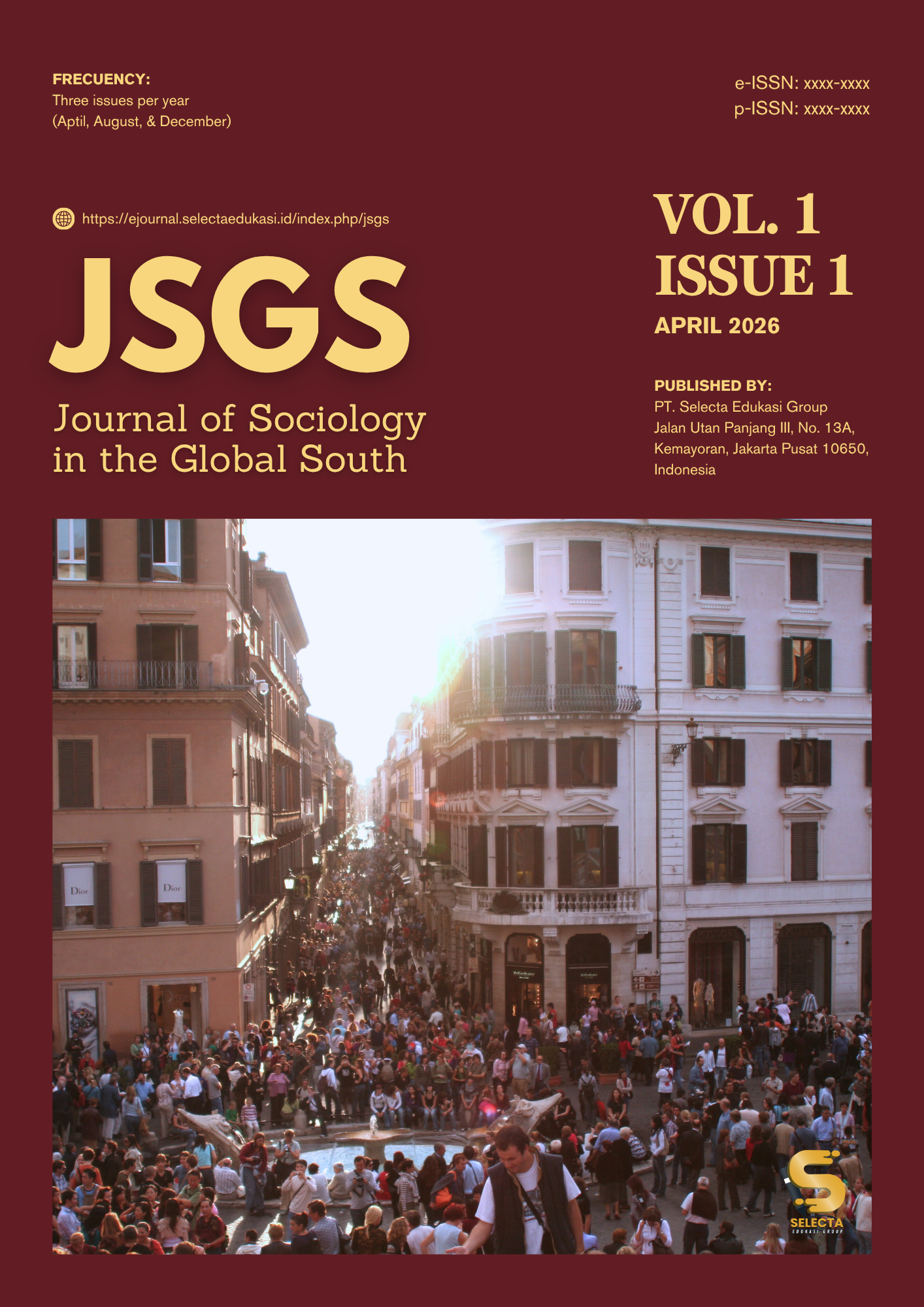
Journal Title : Journal of Sociology in the Global South
Initials : JSGS
Frequency : Three issues per year (April, August, & December)
Online ISSN : 228X8XXX
Print ISSN : XXXX-XXXX
Editor in Chief : Afdhal, M.Si [Sinta ID] [Google Scholar]
DOI : 10XXXXX
Publisher :

PT. Selecta Edukasi Group

Journal of Sociology in the Global South (JSGS) is an international peer-reviewed journal dedicated to advancing sociological knowledge grounded in the diverse social realities of the Global South. The journal seeks to address the imbalance in global knowledge production by promoting theoretically informed and empirically rich studies that reflect perspectives, experiences, and transformations from regions historically underrepresented in mainstream sociology.

JSGS provides a platform for the development of context-sensitive and critical sociological approaches, including decolonial perspectives and Southern epistemologies. It welcomes contributions that engage with contemporary social issues such as development and inequality, urban and rural transformations, digital society, migration, gender and social inclusion, environmental change, and the intersections of culture, religion, and identity. Special attention is also given to island and maritime societies as distinctive yet strategically important contexts within the Global South.

All submissions are subject to a rigorous double-blind peer-review process, ensuring impartial evaluation, academic integrity, and the highest standards of scholarly quality. By fostering interdisciplinary dialogue and global scholarly exchange, JSGS aims to contribute to a more inclusive, reflexive, and globally representative sociology.

Current Issue

Vol. 1 No. 1 (2026): April 2026
					View Vol. 1 No. 1 (2026): April 2026

Volume 1 Issue 1 (April 2026) of the Journal of Sociology in the Global South (JSGS) brings together a set of articles that reflect the journal’s commitment to advancing context-sensitive and critically grounded sociological inquiry from the Global South. The contributions move across interrelated themes of religion, education, culture, and political life, each rooted in the Indonesian experience while engaging broader theoretical conversations. The re-examination of Gus Dur’s cosmopolitan Islam foregrounds an ethico-sociological response to pluralism, while the study on Soekarno positions education as a strategic ideological instrument in postcolonial nation-building. In parallel, the integration of Kalosara and Christian education offers a cultural-theological model of transformational leadership grounded in local wisdom. The analyses of conflict management in a women’s religious study group and the political role of Islamic Religious Education teachers further extend the discussion into everyday institutional practices, organizational communication, and democratic negotiation in plural societies.

What connects these contributions is a shared effort to reposition local knowledge, lived realities, and historically situated experiences as valid sources of sociological theorization. Rather than simply presenting empirical findings, the articles engage in conceptual work by reframing cosmopolitan Islam, educational politics, ethno-theological leadership, and community-based conflict management as productive analytical frameworks. In doing so, this issue not only aligns with the intellectual direction of JSGS but also demonstrates its relevance in contributing to global sociological debates. It offers both theoretical refinement and practical insight, while reinforcing the importance of southern epistemologies in addressing persistent challenges such as inequality, pluralism, and social cohesion.

Published: 2026-04-10
View All Issues